Roots of Belonging

3-minute documentary

While creating my 3-minute documentary “Roots of Belonging,” at Muhlenberg College, I drew from class lessons and insights I gained while being a part of our documentary research class. Documentarians serve to uncover the untold stories and shine a spotlight on narratives that may not be fully recognized. By understanding the power of storytelling, I aimed to capture the essence of Eliana’s experience as a junior, transfer, member of the women’s soccer team and international student from Israel.

Through class discussions of work like “Stranger with a Camera” and “Banished,”, I learned the significance of empathy in documentary filmmaking. A deep understanding of the subject’s perspective is imperative for authentic storytelling. My personal connection to Eliana helped me unfold her narrative and allowed me to approach her story with sensitivity, ensuring her voice would be accurately represented.

Challenges arose in the production process as I struggled to balance the fine line of personal storytelling and addressing broader concepts of diversity, equity, and inclusion. While trying to convey a universal message and maintain a personal touch, the challenges required careful editing and storytelling decisions. I decided to draw on the use of pathos to connect the audience emotionally to Eliana’s experience. Recognizing emotions are a powerful conveying tool, I decided to draw on Eliana’s universal human experience. Her sense of joy, nervousness, and excitement, served as emotional anchors for viewers to empathize with. Documentary making is not just understanding empathy but also about being able to convey it. By emphasizing Eliana’s emotions, the audience can create a bridge between her personal experience and their own emotions. Eliana’s story invites viewers to connect with the human experience of self-discovery and the search for a community that celebrates and appreciates individuality. The use of pathos became a guide for navigating the challenges in production which overall was able to contribute to the overarching themes of belonging within the college campus.
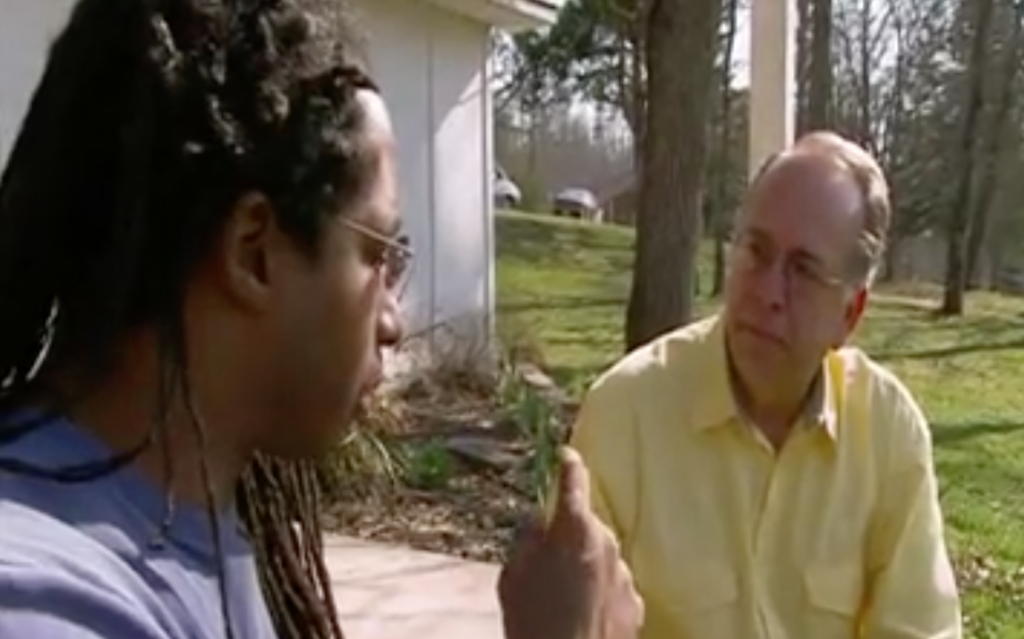

Banished Realities: Confronting Racism in Harrison

In Marco Williams documentary “Banished,” the camera is flipped to watch the filmmaker engage in a revealing interview with Thom Robb, an affiliated member of the Ku Klux Klan. Representing the Klan, Robb asserts a desire to “preserve our community, our culture” (1:04:10), even the heritage he deems worthy of preservation. However, Williams challenges this narrative by stating that the burning cross has a history of scaring Black communities. This exchange highlights the deep racial issues in Harrison, forcing the audience to be confronted with the uncomfortable truth that racism still exists and is not just a relic of the past. This important dialogue exposes the conflict between real life racial issues and the town’s self-image. It urges viewers to carefully examine where the roots of prejudice arise from and how individuals like Robb contribute to a divisive narrative. 

Belonging on the Field

In the process of creating this short documentary, the limitation of 30-second runtime challenged me to convey the deep emotional connection of belonging. I wanted to make viewers understand the nature of belonging with my script and included photos. Visuals showing the team huddled together and myself, pictures at the end, reinforce the concept of unity and how my sense of belonging feels like family and I can be “my authentic self”. The idea that my sense of belonging is at Muhlenberg College also creates the idea of belonging relatable to the audience, as most viewers can relate to belonging in the context of a school or community. In a brief and emotional manner, I believe I accurately communicated the essence of belonging.

Doing Documentary Work: Balancing Participation and Detachment

“Besides, to write particular words or to take specific pictures is to stand at some remove from the entire range of what can be said or photographed, and to take such a step moves one at least a measure away from that full participatory zeal that some activists hold up for themselves and for others as ideal”

Robert Cole, Doing Documentary Work (page 33)

This quote from Robert Coles’ “Doing Documentary Work” offers a perspective on the tension between observation and participation in the field of documentary work. It highlights the nature of documentary work and challenges the notion of “full participatory zeal” embraced by activists. 

What strikes me the most about this quote is the idea that by engaging in a subject, we are inevitably distancing ourselves from the unfiltered experience. In other words, the act of documenting creates a degree of detachment, we must select and interpret what we observe. 

Finally, this quote reminds us that as documentarians, we must navigate the line between engagement and objective representation. Our choice of imagery and words convey and shape a narrative. And with that, we must depict reality honorably.

css.php